Jerry Kindall
AI & Product Experience Leader, Builder, Writer and More
Developer Experience | Documentation Engineering
Docs as code | AI | Python | Stack Overflow top 0.1%
CoPilot Webhooks Guide Open Guide
Webhooks developer guide for CardConnect CoPilot at Fiserv. Includes webhook setup and integration, signature validation, and security guidance.
JFK Hoover Bot View PDF
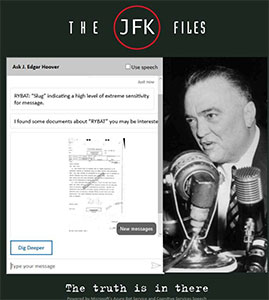 Tutorial for building a web application that orchestrates four Azure services to
provide a chat-style interface for searching declassified documents related to the
JFK assassination. The four services are:
- Microsoft Bot Framework
- Azure Cognitive Search
- Azure Speech recognition with custom speech model
- Azure Speech synthesis with custom voice model
This application includes server-side code in C# and client-side code in JavaScript.
Snowflake Cortex AI Functions Guide Open Guide
As the first writer on Snowflake's AI and ML topics, I established the information architecture for the Cortex AI Functions topics and authored the initial content. This work includes the overview page, the subordinate guides for each significant piece of AI functionality, and the associated SQL reference topics.
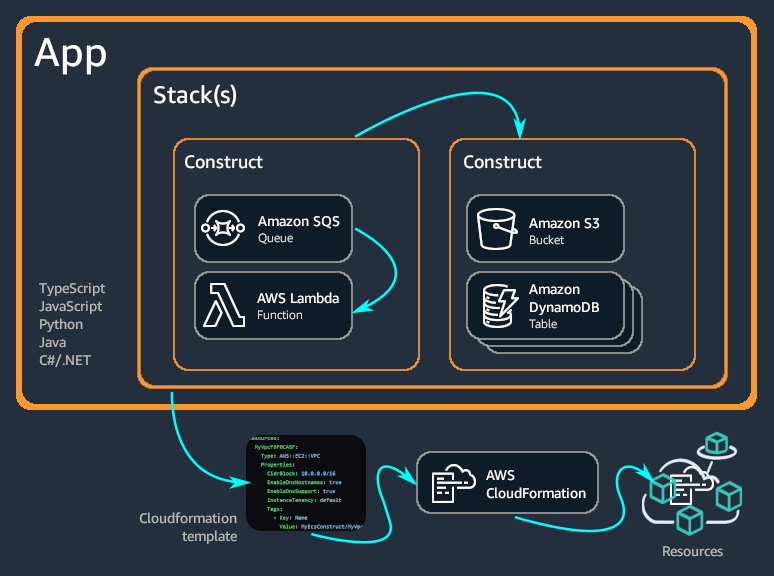
AWS Cloud Development Kit (CDK) Developer Guide Open Guide View PDF
I authored the AWS CDK developer guide from scratch and shepherded it through two major releases. You'll notice code examples in multiple programming languages, including TypeScript, Python, Java, and C#. Particular high points include:
- Core AWS CDK concepts:
Constructs - Environments - Context - Tagging - Resources - Bootstrapping - Higher level topics:
AWS CDK Toolkit (CLI) - Testing Constructs - Best Practices - Abstractions and escape hatches
How to write terrible SQL View Article
A blog post for Espresso AI about a common performance issue in SQL queries.
Tic-Tac-Toe: A Simple, But Ultimately Futile, Game of StrategyView PDF
The brief for this sample was "explain a simple game as if the reader has never heard of it." A fun exercise!
Code Snippet Extractor View on Github
I completely rewrote the AWS Code Examples' snippet extractor to improve functionality and error handling. The first run of this tool found issues with the code example snippet markers that had existed for years.
Tecplot Welcome Screen
As part of a product modernization effort, I developed the Welcome Screen that appears when Tecplot products are launched. The Welcome Screen provides quick access to recently-opened files, documentation, and support information. The feature was adopted in all Tecplot products. Eventually, it was extended to provide launch analytics, a customizable banner for displaying product news, and the ability to block known pirated serial number from being used with the product.
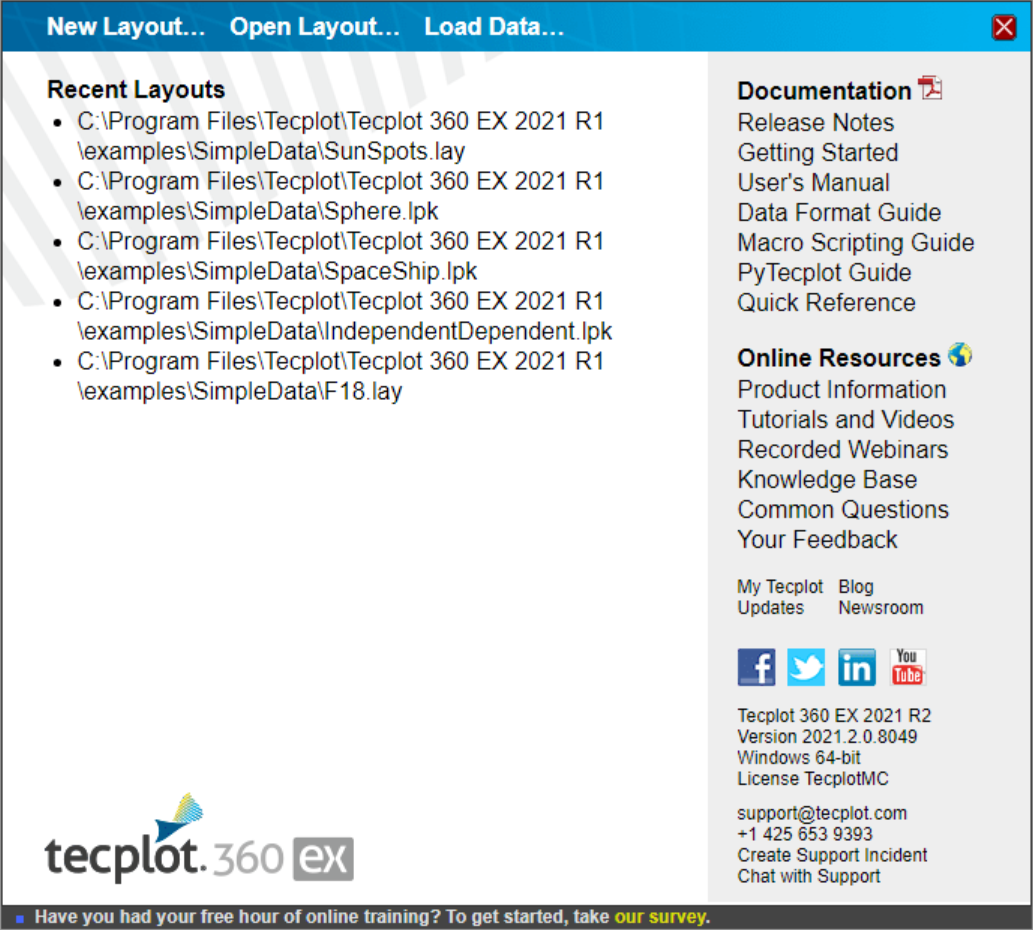
The Welcome Screen is implemented in HTML and JavaScript and is displayed in an embedded Qt browser control. A simple API allows the Welcome Screen to be driven by the host application.
The Welcome Screen also includes a basic REPL to inspect its internal state, so it can be debugged more easily in situ.
Tecplot Documentation Build and Tooling
When I arrived at Tecplot, their FrameMaker-based documentation build system had a serious bug that resulted in extra blank pages appearing in documents where pages had been conditionalized out. I addressed this issue, then went on to add:
- Continuous integration and deployment (CI/CD) so that checking in documentation changes automatically triggered a build
- PDF regression testing to make sure bugs I'd fixed in the documentation build system stayed fixed
- Automated help builds replacing a manual tool that was so finicky it could take two weeks to ready help for a release
- Link checking to ensure all links in the documentation work (caught one site's incorrect status codes with this)
- White label builds to provide rebranded documentation for specific clients without having to retake all screen shots
- Stemming search with spelling corrector to allow customers to find relevant information even with typos
Additionally, I:
- Advocated for shipping our own help viewer instead of relying on the customer's browser to display HTML help, addressing consistency issues across browsers and operating systems
- Created a Windows tool that overrides Tecplot applications' title bar to make screenshots generic (no product version number)
Selected Personal Projects
- Shell tools for use with bash or zsh on Linux or macOS
- Spelling Bee generator and solver for the popular New York Times daily puzzle
- OneWindow, a Chrome extension that keeps all open tabs in a single window
Stack Overflow Answers
I've contributed more than 2,300 answers to Stack Overflow. Here are some of my favorites:
How to get the return value from a thread?
How to capture stdout output from a Python function call?
Rotating a two-dimensional array in Python
How do I print functions as they are called?
Python dictionary keys besides strings and integers?
Detect if an image is completely black or white
How to get current function into a variable?
Booleans have two possible values. Are there types that have three possible values?
What is the fastest way to flatten arbitrarily nested lists in Python?
How can I detect duplicate method names in a Python class?
Is it possible to see variable scope of just called function in Python?
Enforcing Class Variables in a Subclass
Exceptions for the whole class
Python HTMLParser dividing data at &
How can I write a Python decorator to increase stackdepth?
Python multiple inheritance not showing class variables or method of second inherited base class
Can pexpect be told to ignore a pattern or signal?
Cerberus: allow any key name in a dictionary schema?
How to fuse multiple Python functions together
Function which computes once, caches the result, and returns from cache infinitely
Python try/except block inside lambda
Does the @property decorator cache results?
How can I intercept calls to python's "magic" methods in new style classes?
This one got a mention in the EasyBuild documentation!
Prototype AI Technical Editor persona
Early on at Fiserv, I was tasked to update my team's style guide. At a technology company, almost everyone writes technical prose, even if writing is only part of their job. These incidental writers aren't going to memorize dozens of rules from a style guide. So I split the style guide into two parts: an AI persona that knows all the fiddly style rules so it can offer improvements, and an empathetic writing framework that helps authors evaluate and improve their own writing via a handful of easy-to-remember principles.
The Inference: Drawing conclusions about AI Read blog
My blog on artificial intelligence, including explanations of core concepts, the legal and social implications of AI, and my experiences with the technology.
The Charlie Project Visit GitHub repository
An experiment in writing clearer instructions for AI. AI produces better results when it receives clear, complete instructions. Charlie endeavors to provide a framework for writing unambiguous instructions that LLMs can follow more effectively.
Mister Sparkle Visit GitHub repository
An experiment in preserving engaging prose across languages. Documentation that people enjoy reading often has a distinct voice: rhythm, well-chosen idiom, concrete examples, and sometimes humor. Those same engaging qualities can make documentation hard to translate. Mister Sparkle aims to retain reader engagement while improving translatability.
Rugrat AI: The world's most toddler intelligence in the world Visit site
Just for fun, a playful spoof of AI bots with all the intelligence of a 36-month-old human.
This is my origin story. Superhero or supervillain? You be the judge...
The beginnings
As a kid, I wanted to be a writer as soon as I realized books were written by regular people. Hey, I was a regular people!
Then in middle school, I discovered computers… specifically, the Apple II. A machine that would do my bidding without talking back was a rush for a kid who was just beginning to make his own decisions. In high school, I taught myself BASIC and 6502 assembly language from books and magazines, and learned Pascal in AP Computer Science. (Scored a solid 5 on the AP test, too.) I also started my school's Apple II User Group and, with a fellow student, wrote a science fiction spoof titled Starship of Fools.
Later, as a burgeoning adult, I discovered technical writing: the career that combined words and code, the two passions of my young life. I never stopped coding.
Kitchen Sink Software
I put myself through college writing Apple II software for Kitchen Sink Software, which published a CAD package for schools. I wrote graphics routines in 6502 assembly language, as well a disk operating system utility, MicroDot. I still occasionally fantasize about putting together MicroDot 2.0.
Apple II RoundTables
The GEnie online service (operated by General Electric using unused capacity on their GEIS timeshare network) was the online home of the Apple II community. I became a forum assistant on the Apple II RoundTable and later represented my employer of the time, Quality Computers, there.
KansasFest
Formally known as The A2-Central Developer's Conference, KansasFest was an annual event held in Kansas City, Missouri (hence the nickname) focused on Apple II development. I presented there twice:- The Text Editor from Hell: Explored the inner workings of a simple text editor I'd written in 6502 assembly language.
- Combining BASIC and Assembly: Presented a technique for combining BASIC and machine code in a single file.
Quality Computers
A mail-order retailer that began offering own-branded products to improve margins, Quality Computers offered me ample opportunity to learn new skills and find my path. I started in technical support, then did inbound sales, and finally became involved in products.
- I founded and served as editor-in-chief of II Alive, the last glossy Apple II magazine, when IDG's A+/InCider ceased publication. (I also wrote much of the content under pseudonyms.)
- When Quality Computers obtained the rights to release a new version of a popular Apple II integrated pacrkage, AppleWorks, I produced the documentation for the upgrade, including a completely new manual design, 100+ pages of new material, and significant updates on the majority of existing pages.
- I was product manager of our grammar checker add-on for AppleWorks and developed the phrase files for the product.
- I developed software for several of Quality's own-brand products, including a setup utility for their external hard disk and a test utility for their memory expansion card, along with standalone utilities Switch Hitter and FlashBoot.
- I developed and operated theLINQ, Quality's Interent service for education. (The name stood for The Learning and Instruction Network from Quality.)
- I wrote several promotional and instructional videos and helped produce them in our internal video studio, which we'd acquired from AmigaWorld magazine. I even appeared in some of them...
Manual Labor
After Quality Computers, I started a freelance technical writing and Web design consultanty. Under the brand Manual Labor, I:- Deveolped Quality Computers' first webstore, much of it in C.
- Wrote the user manual for the NovaServer Internet community server for ResNova. (Alex Hopmann, who later invented AJAX, was the company's founder and president.)
- Wrote documentation for numerous products including a production management application with integrated accounting, the Mac version of id Software's Hexen, a DVD authoring tool, and Bare Bones Software's BBEdit (you'll still find my name in that product's About box).
- Contributed to and edited small Apple II programming journals, including 8/16, The Sourcerer's Apprentice, and Reboot.
- Served as Products Editor for MDJ (a daily Macintosh journal) and contributed to Mac journal TidBITS.
- Wrote The Web Motion Encyclopedia for Waite Group Press.
Freeware
I released a couple of Apple II utilities (and one game) as freeware:
- XTRAX: Self-extracting archive builder for distributing Apple II compression utility ShrinkIt to address the "how do I unpack my packer" paradox of online program exchange.
- LIGHT: A line editor for BASIC programs in about 200 bytes of assembly code.
- Meteor Storm: An arcade game that used the Apple II's text mode rather than graphics. While it was visually crude, some players reported that it was surpisingly addictive. "Just one more game..."
The saga continues
My early experience led directly to what I do now: using words and code to help developers get things done.☑ Wish Granted Read
A short story about a man, a genie, and another man. Content warning: post-apocolypse; swears.
The greatest guitar player in the world sat, by long-established habit, atop the tallest pile of smoking rubble in the world. A panting acolyte perhaps nineteen years old climbed up over the edge of the platform on which he sat. It had once been a ping-pong table; now it was a sort of home for a man with a near-supernatural malodor and an extinct cigarette of uncertain provenance dangling from his lip. »»»
Quantum Mechanics
I used to have a spare bedroom full of synthesizers and used them to compose and produce this track, inspired by Tangerine Dream and Alan Parsons instrumentals.
AWS CDK Constructs and Stacks
I made this diagram for the AWS CDK Developer Guide.